AI Visibility Checker

Patients now ask an assistant who to see before they open Google. Those answers are built from what the wider web says about you, not from your website alone. This check asks the questions patients in your city actually ask, across five assistants, and records whether you are named, where you sit in the answer, and which pages the answer was built from.

Run the AI visibility auditRuns inside RepHigh · free to monitor
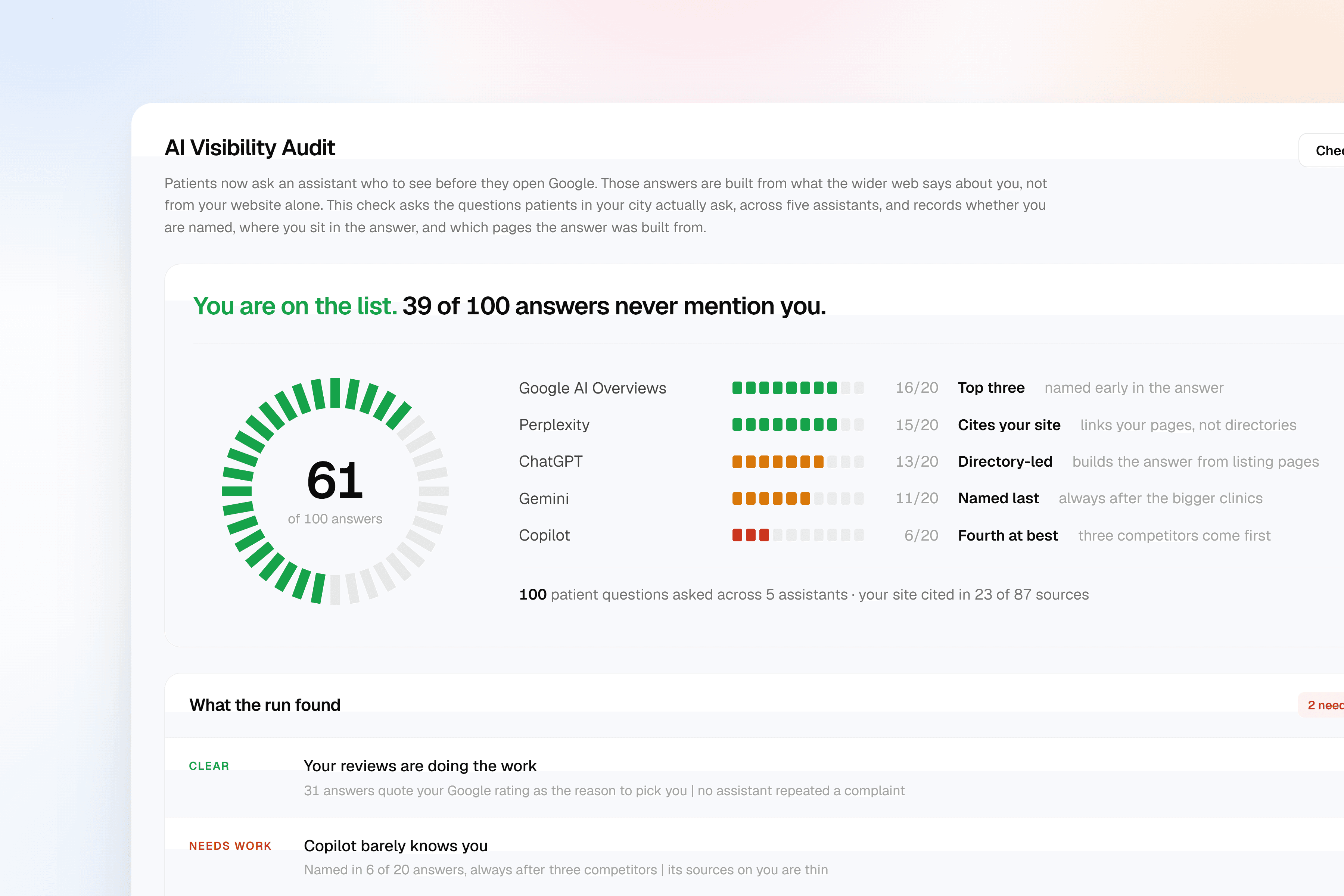
An AI visibility audit recording how often a clinic is named across Google AI Overviews, Perplexity, ChatGPT, Gemini and Copilot

How to use the free AI Visibility Checker

  1. 1

    Enter your clinic and the website patients are sent to.

  2. 2

    We ask real patient questions across five assistants, then read your site for why.

  3. 3

    Fix what the run points at, and ask the same questions again.

What is RepHigh’s AI Visibility Checker?

It is a free check for private clinics in Dubai, and it has two halves. The first asks a set of real patient questions across Google AI Overviews, Perplexity, ChatGPT, Gemini and Copilot, and records what came back: whether your clinic was named, how early, and which pages the assistant built its answer from. The second reads your website the way those systems read it, and explains why the first half came out the way it did.

AI answers are assembled from pages that state facts plainly and can be reached without running JavaScript. A site that hides its prices behind a form, its hours behind an image and its treatments behind an animation is a site those systems skip.

The check looks at what a crawler can actually reach, whether the answers patients ask for exist in text, how the page is structured, and whether the technical basics let an AI crawler in at all.

What it will never do is promise you a position. A single AI answer proves nothing: ask the same question twice and the wording, the order and sometimes the clinics change. What a fixed set of questions, asked on a schedule, does give you is a rate, and a rate is measurable. Being named in most answers is a result. Being named in one is an anecdote.

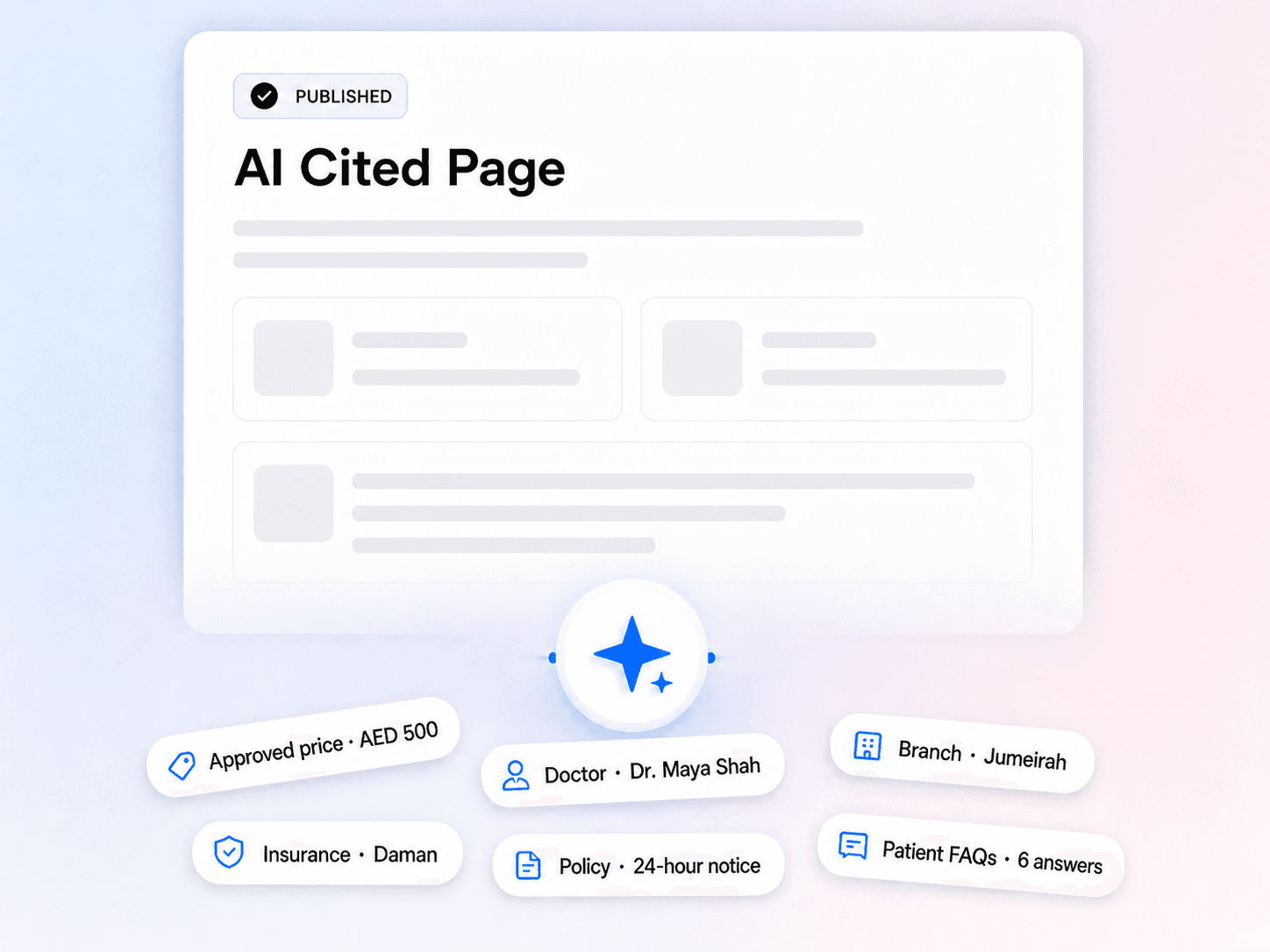
A published clinic page carrying the facts an assistant needs to quote it: an approved price, the treating doctor, the branch, the insurer accepted, the cancellation policy and six patient FAQs
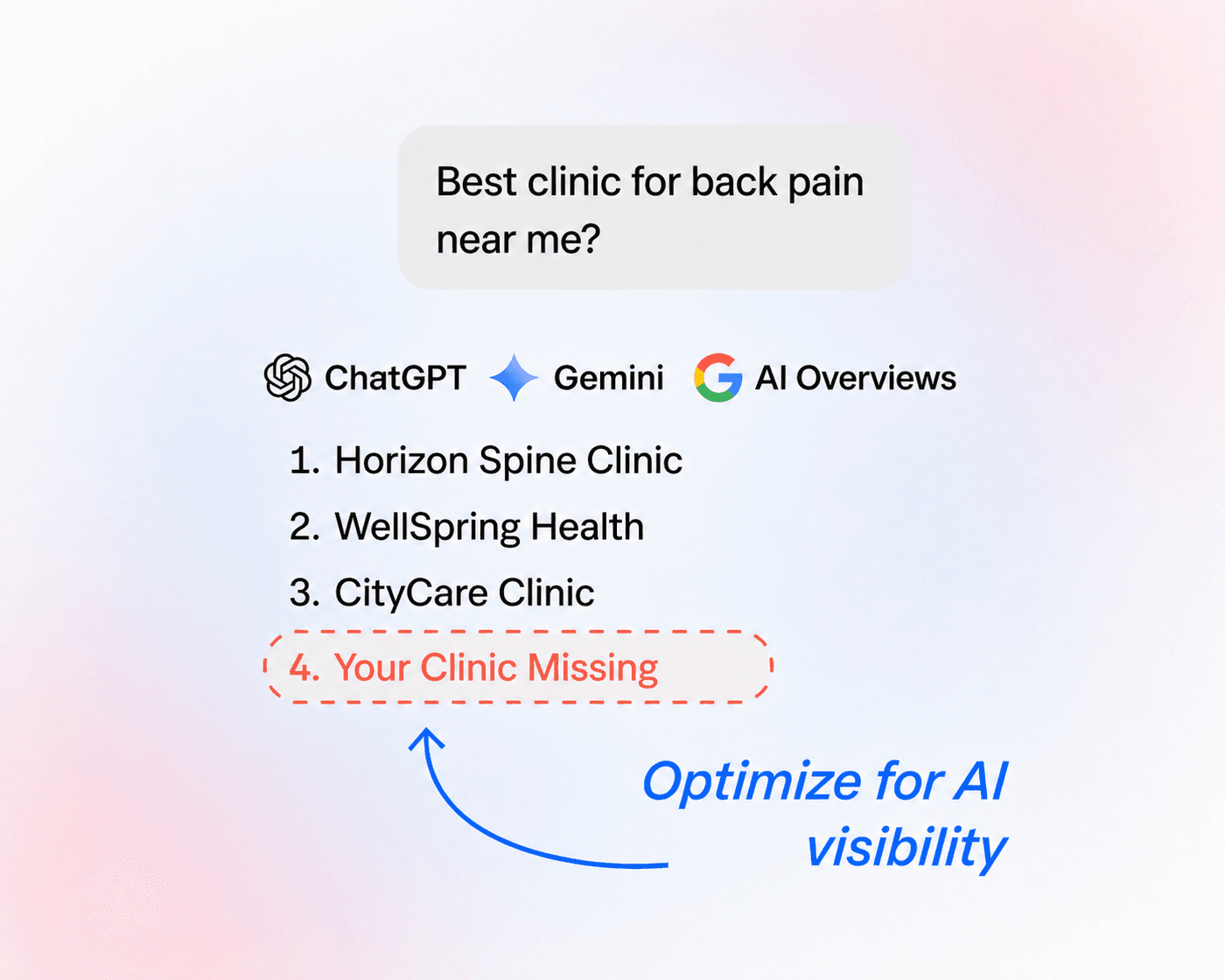
An AI answer listing nearby clinics with one missing

Why your AI visibility matters

Search used to hand a patient ten links to compare. Increasingly it hands them one answer with two or three clinics named in it, and the rest of the page never gets read.

That makes the question different. It is no longer only “do I rank” but “is there a sentence on my site that an AI system can lift and attribute to me”.

Clinics are unusually badly placed for this. The facts patients ask for are exactly the facts most clinic sites decline to publish: what a treatment costs, who performs it, which insurers are accepted, how long recovery takes.

The clinics that will be quoted are the ones that answer plainly, in text, on a page a crawler can reach. That is not a trick, and it is not new: it is the same thing that made a page worth ranking.

Turn your check into always-on AI visibility management

The check tells you which answers you are missing from and why. RepHigh LLM Citation AI builds the pages that fill those gaps, from knowledge your clinic has approved rather than invented copy.

It then verifies what actually reached your live site, so a page that was written and never published does not sit in a report looking like progress.

See LLM Citation AI
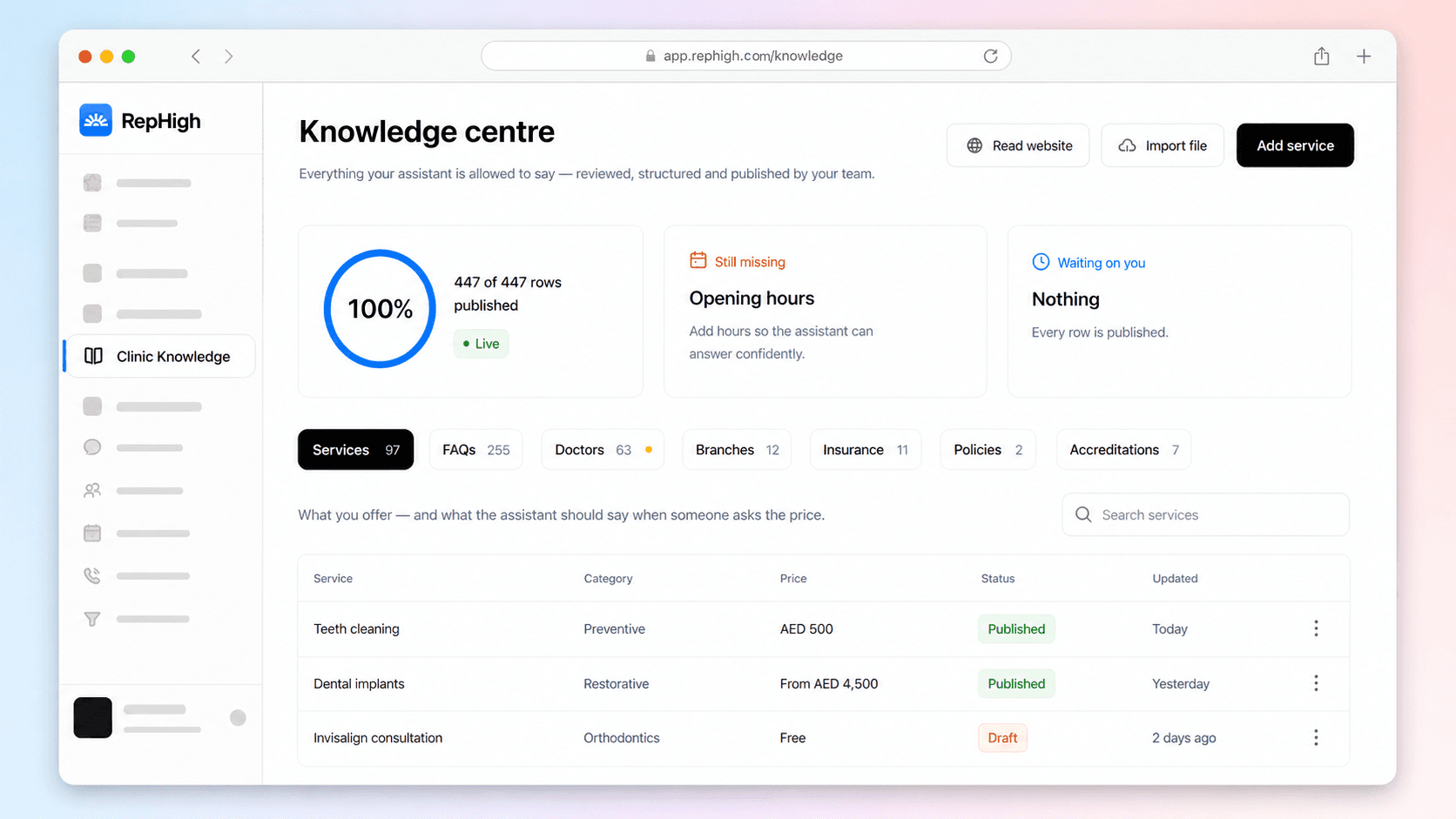
A clinic knowledge centre with every service, price and status published, and the one field still missing named at the top

Which signals do we read?

Five signals, read on and around your site once the run has finished asking. These are what explain a low rate, and every one of them is something you can change this month.

  • Crawler access: Whether the crawlers behind AI search are allowed to reach your site at all: GPTBot and OAI-SearchBot for ChatGPT, PerplexityBot, ClaudeBot, and Google-Extended for Google. This is a gate rather than a score, so it is read first. If one of them is disallowed, that is the complete explanation for never being quoted by that platform, and no amount of work on the four signals below will change it. It is also a single line in robots.txt, and most clinic sites that block them inherited the file from a template nobody opened.
  • Server-rendered content: Whether your pages carry their words in the HTML or assemble them in the browser after a script runs. AI crawlers do not execute JavaScript, so a site that loads its treatments, prices and doctor profiles client-side looks to them like an empty page with a navigation menu attached. This is the most expensive fault on the list and the hardest to spot, because in a browser the site looks perfect. View the page source and search it for a treatment you offer. If the word is not there, no assistant can see it either.
  • Answerable facts: Whether the questions patients actually ask have written answers anywhere on your site: what a treatment costs, who performs it, which insurers you take, how long recovery runs, whether you see children. A page saying “contact us for pricing” has answered nothing an assistant can lift. You do not need a number to be quotable, only a sentence: “from AED 500” and “priced after consultation, usually two visits” are both answers. “Get in touch” is not.
  • Passage structure: Whether those answers can be extracted without the rest of the page. Assistants lift passages, not documents, so what matters is a clear heading hierarchy, paragraphs that make sense on their own, and tables for anything comparative. A fact buried in the fourth sentence of a paragraph on page four is a fact no system will lift, however true it is. Forty plain words under a question-shaped heading beats a beautifully written page that never states the answer outright.
  • What the wider web says: Assistants build answers from more than your website. When they cannot use your pages they fall back on directories, review profiles and listings, which is why one assistant cites your site and another answers from a directory that has your old phone number. So this reads the sources being quoted about you and whether they agree: one clinic name, one address, one description, matching your Google profile. A clinic described three ways is a clinic no system can resolve into one entity, and an entity it cannot resolve is one it will not name.

Crawler access is read first because it is a gate rather than a score. If the crawlers are blocked, the other four signals cannot help you until that one line in robots.txt is changed, however good the site behind it is. The other free checks: Business Profile Checker, Listings Checker, Google Reputation Checker.

How to read your visibility score

The score is the share of answers that named your clinic. Ask a set of real patient questions across five assistants, count the answers you appear in, and that count out of the total is the number. It is a measurement of what came back, not a forecast of what will.

Read it as a rate rather than a verdict. One answer that names you proves nothing, because asking the same question again can reorder the clinics or drop one entirely. A rate across a whole question set is stable enough to compare with last month, which is the only comparison worth making.

The per-assistant rows matter more than the total. Being named in most Google AI Overviews and almost never in Copilot is a different problem from being named evenly but always last, and the two are fixed in different places.

Where you sit in an answer counts as much as whether you are in it. A patient reads the first two clinics named and rarely the fourth, so moving from fourth to second inside the same answer is worth more than appearing in one extra answer.

The five signals below explain the score rather than make it up. When the rate is low, the cause is almost always down there: a crawler that was never let in, or answers that exist on your site only after JavaScript runs.

Treat it as a baseline. Fix the signal the run points at, then ask the same questions again next month and watch the rate rather than any single answer. The comparison against nearby clinics, shown alongside, is what LLM Citation AI adds on top.

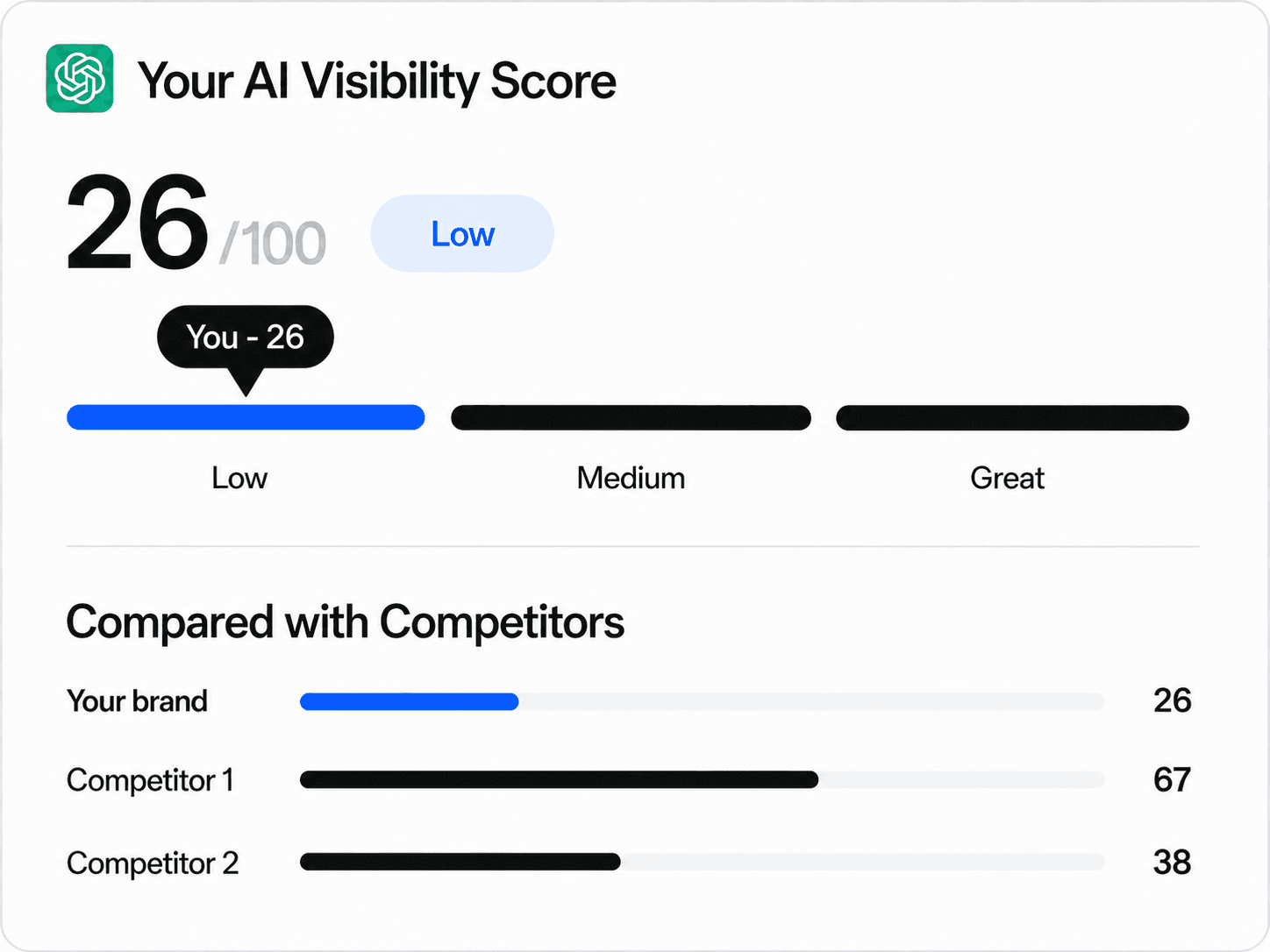
An AI visibility score of 26 out of 100 in the Low band, shown beside two nearby clinics scoring 67 and 38

How to improve your AI visibility

Five changes that make a clinic site worth quoting, cheapest first. The first takes ten minutes and unblocks everything under it.

Let the crawlers in

Open robots.txt and look for GPTBot, OAI-SearchBot, PerplexityBot, ClaudeBot and Google-Extended by name. A blanket block is rare; what happens instead is that two or three arrive disallowed in a website template and stay there for years. Ten minutes to check, one line to fix, and until it is done nothing else on this list can help you.

Serve the words in the HTML

If your site builds its content in the browser, the crawlers see an empty shell where your treatments should be, and every other improvement lands somewhere they will never look. This is the one item on the list you cannot do yourself, because it is a decision for whoever builds the site. It is also the difference between existing to these systems and not.

Publish the price, or publish the policy

A number where you have one and a plain sentence where you do not: “from AED 500”, or “priced after consultation, usually two visits”. Both are quotable and both are honest. “Contact us for pricing” is neither, and it is the single most common reason a clinic page loses an answer to a competitor who simply said what things cost.

Answer the questions in text, near the top

One page per treatment, with the questions patients actually ask as headings and short answers beneath them. Forty words is plenty, because these systems lift passages rather than pages. Put the answer in the first sentence under the heading rather than building to it, since a conclusion at the bottom of a long page is a conclusion nothing will reach.

Say who you are, the same way everywhere

One clinic name, one address, one description, matching across your Google profile, your directories and your own site. This is the least interesting item here and the one clinics most often fail, usually because a rebrand reached the website and nowhere else. A system that cannot resolve which clinic you are will not name you, however good the pages behind you are.

RepHigh, in-house, or an agency

The same work, done three ways. What differs is who carries it, how fast it happens, and what it costs you each month. The plans are on pricing.

CapabilityRepHighCitation planDo it yourselfMarketing managerHire an agencyRetainer
What gets publishedPages built only from facts your clinic approvedWhatever there is time for that monthGeneralist content, written to a brief
Proof it reached your siteThe live page is read back and comparedAssumed, because nobody checksReported as delivered
Crawler accessChecked on every read, and it is a one line fixBlocked by a template nobody has openedSometimes checked, often not
What is promisedA rate that is measured, never a position promisedNothing is promised to anyoneSome sell ChatGPT rankings nobody can deliver
How progress is measuredThe same score, re-run after you publishA feeling that it must be workingA screenshot of one good answer
Your team’s time each monthReading and approving, nothing elseSeveral hours, never billed to anyoneBriefing calls and report meetings
What it costsOne fixed subscription, whatever the volumeNothing on paper, paid in staff hoursA retainer, usually the largest of the three

AI visibility questions, answered

Rubric and copy last updated 14 August 2026.

How do I get my clinic mentioned by ChatGPT?

By being the easiest clinic to quote, because there is nothing to buy. No tool and no agency can guarantee that an AI assistant names your clinic: the platforms control their own citation logic, change it often, and vary what they say by user, by phrasing and by day. Anyone selling you a guaranteed ChatGPT ranking is selling something they do not control. What you do control is whether there is anything quotable on your site. That means treatment pages that answer the questions patients actually ask, in text, in full sentences a system can lift. It means a price where you have one and a plain statement of your pricing policy where you do not, because "contact us for pricing" answers nothing. It means one consistent description of who you are. And it means letting the crawlers in, which is where most clinic sites fail before any of the rest matters.

Do AI crawlers read JavaScript?

No. The crawlers behind AI search fetch your HTML and read what is already in it. They do not run your scripts and they do not wait for your page to assemble itself. A site that loads its treatments, prices, hours and doctor profiles in the browser after JavaScript runs looks to those crawlers like an empty page with a navigation menu attached. This is the most expensive technical mistake a clinic website can make for AI visibility, and it is also the hardest to notice, because in a browser everything looks perfectly fine. The test is simple: view the page source rather than the rendered page, and search it for the name of a treatment you offer. If the word is not there, no AI system can see it either. Fixing it is a decision for whoever builds your site, not a content change.

Which AI crawlers should a clinic allow in robots.txt?

GPTBot and OAI-SearchBot for ChatGPT, PerplexityBot for Perplexity, ClaudeBot for Claude, and Google-Extended for Google’s AI features. Check your robots.txt for each of those names specifically, because a blanket rule is not the usual problem: what happens far more often is that a clinic site inherits a template with two or three of them disallowed and nobody ever reads the file. If any of these are blocked, that is a complete explanation for never being quoted by that platform, and it is a one line fix. Note that some fetchers ignore robots.txt by design, including ChatGPT-User, which acts on behalf of a person who asked for your page. Robots rules never reach those, so robots.txt is a visibility control rather than a security one.

Do I need an llms.txt file?

No. Google states plainly in its own AI optimization guidance that it ignores llms.txt for Search, including its AI features, and that adding one will neither help nor harm your visibility. Google’s John Mueller has separately called the discovery use case a dead end. It remains optional for other AI services, and keeping one costs nothing, but it is not a ranking lever and no honest audit should score you on it.

Is AI visibility different from SEO?

Far less than the labels suggest. Google’s own published guidance says that optimising for its generative AI features is the same work as search engine optimisation, and that AEO and GEO are new names for it rather than new disciplines. Clear answers, pages a crawler can reach, a consistent identity, content worth quoting: the surfaces changed and the fundamentals did not. What is genuinely new is where the answer gets read. A patient who once compared ten links now reads one answer naming two or three clinics, so the question shifted from whether you rank to whether there is a sentence on your site worth lifting and attributing to you.

Why does my clinic appear on Google but not in ChatGPT?

Because they are different systems reading your site with different crawlers and drawing on different pools of sources. A strong Google ranking does not carry across, and the two are not even reliably consistent with each other: a page cited in one AI answer is frequently absent from another for the same question. The most common single explanation is access. Google indexed your site years ago with Googlebot, while GPTBot may never have been allowed in at all, and a robots.txt inherited from a website template is enough to cause that. After access, the usual cause is that your site ranks on pages built to persuade rather than to answer. Google will rank a beautifully designed page that says "contact us for pricing". An AI system needs a sentence it can lift and attribute, and that page does not contain one. The signals behind all of this are universal, though RepHigh is built for private clinics in Dubai and the wider UAE, and the questions the run asks are the ones patients in your city actually ask.

Stop guessing what patients see when they look you up.

The free checks tell you where your clinic stands today. RepHigh keeps it there, across reviews, your Google profile and every directory patients search.