Google Reputation Checker

Check any Dubai clinic’s public Google reviews in one go. See the star rating, how often reviews arrive, how many carry a reply, and which complaints are still sitting unanswered. Then a score out of 100, built from four signals, and what to fix first.

3 free checks a day
For example:
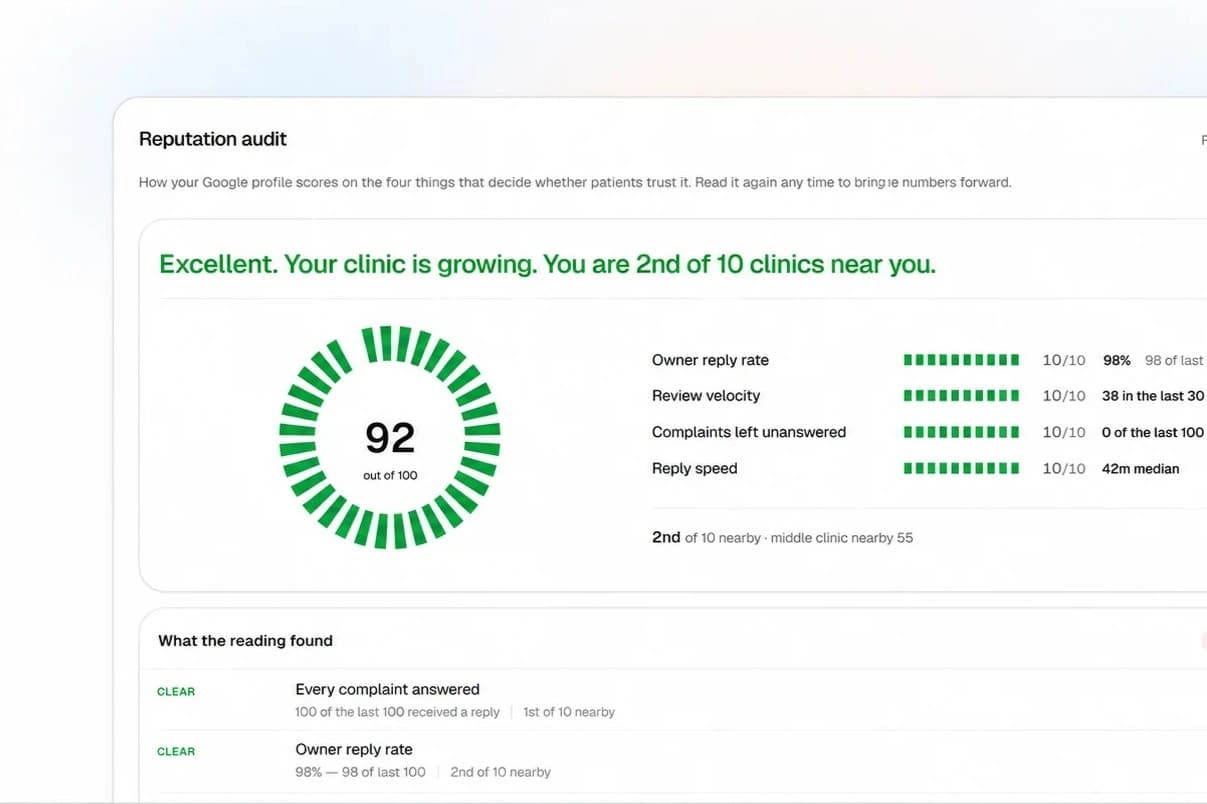
A RepHigh reputation audit scoring a clinic 92 out of 100 across owner reply rate, review velocity, unanswered complaints and reply speed

How to use the free Reputation Checker

  1. 1

    Start typing your clinic name and pick it from the Google listings that appear.

  2. 2

    Press “Check reputation” and we read the most recent public reviews on your profile.

  3. 3

    Read your score, then work down the weakest signals first.

What is RepHigh’s Google Reputation Checker?

It is a free audit that reads your clinic’s public Google reviews and finds the gaps that quietly cost you patient enquiries.

The check returns an overall reputation score, the four signals behind it, and every recent complaint that has not been answered.

It looks at your star rating and its distribution, how many reviews arrive and how recently, how many carry a reply and how quickly it went up, and which negative reviews were left alone.

Those signals feed how patients read your profile before they call, and how Google ranks you against the clinics beside you in local results. The same reading sits behind RepHigh Reputation Monitoring.

Start with the weakest one, fix it, then run the check again to see the number move.

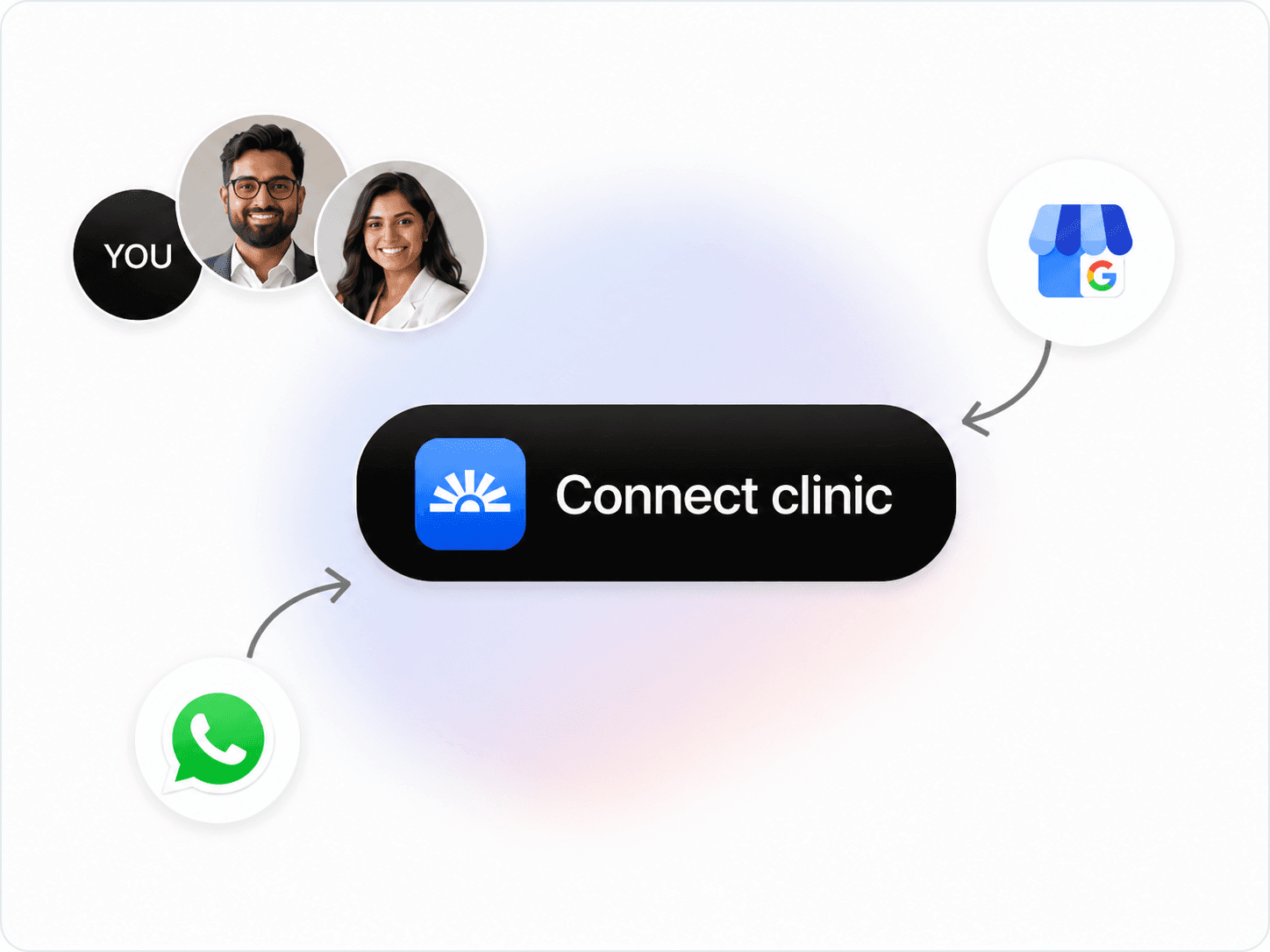
A clinic connecting its Google Business Profile and WhatsApp to RepHigh
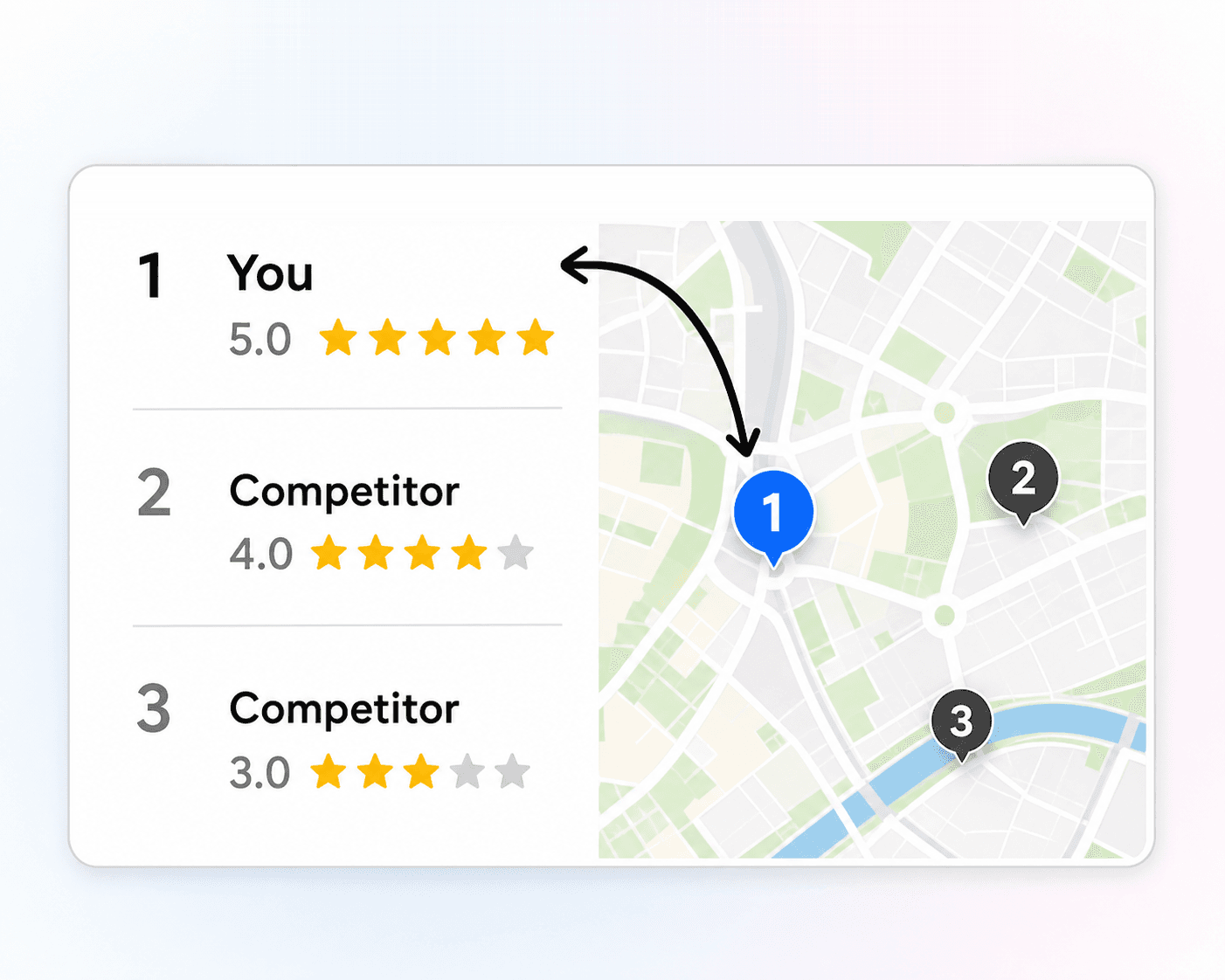
A clinic ranked first on Google Maps at 5.0 stars, above two competitors on 4.0 and 3.0

Why your Google reputation matters

Your reputation decides whether you are in the conversation at all when someone searches for a clinic like yours. The comparison happens before anyone speaks to you.

Patients arriving through search are close to booking. They have already described their problem, compared a shortlist, and are looking for a reason to pick one practice over another.

Reviews are that reason. 97% of consumers read reviews for local businesses, per the BrightLocal Local Consumer Review Survey 2026, a representative panel of 1,002 US adults. A recent, well-answered review set reads as a clinic that is busy and listening. A stale one reads as risk.

Answering them is the second decision, and the one most clinics get wrong. In the same survey, 89% of consumers expect a business to reply to reviews, and a templated reply makes 50% of them less likely to choose that business. A form letter under every review is not neutral. It is read as evidence that nobody is really there.

Google reads the same signals. Rating, volume, recency and replies all feed local ranking, so a weak profile costs you visibility as well as trust.

Checking regularly shows you where you stand, which clinics appear ahead of you, and what a prospective patient sees on the day they decide. The same question is now being asked of AI assistants, which we cover in will ChatGPT recommend my clinic.

Turn your check into always-on reputation management

The free checker is a snapshot. RepHigh Reputation Monitoring watches every new review across your locations, drafts replies in your clinic’s voice for approval, and asks patients for a review after every completed visit.

It also tracks the clinics beside you, so you can see the gap rather than guess at it.

See Reputation Monitoring →
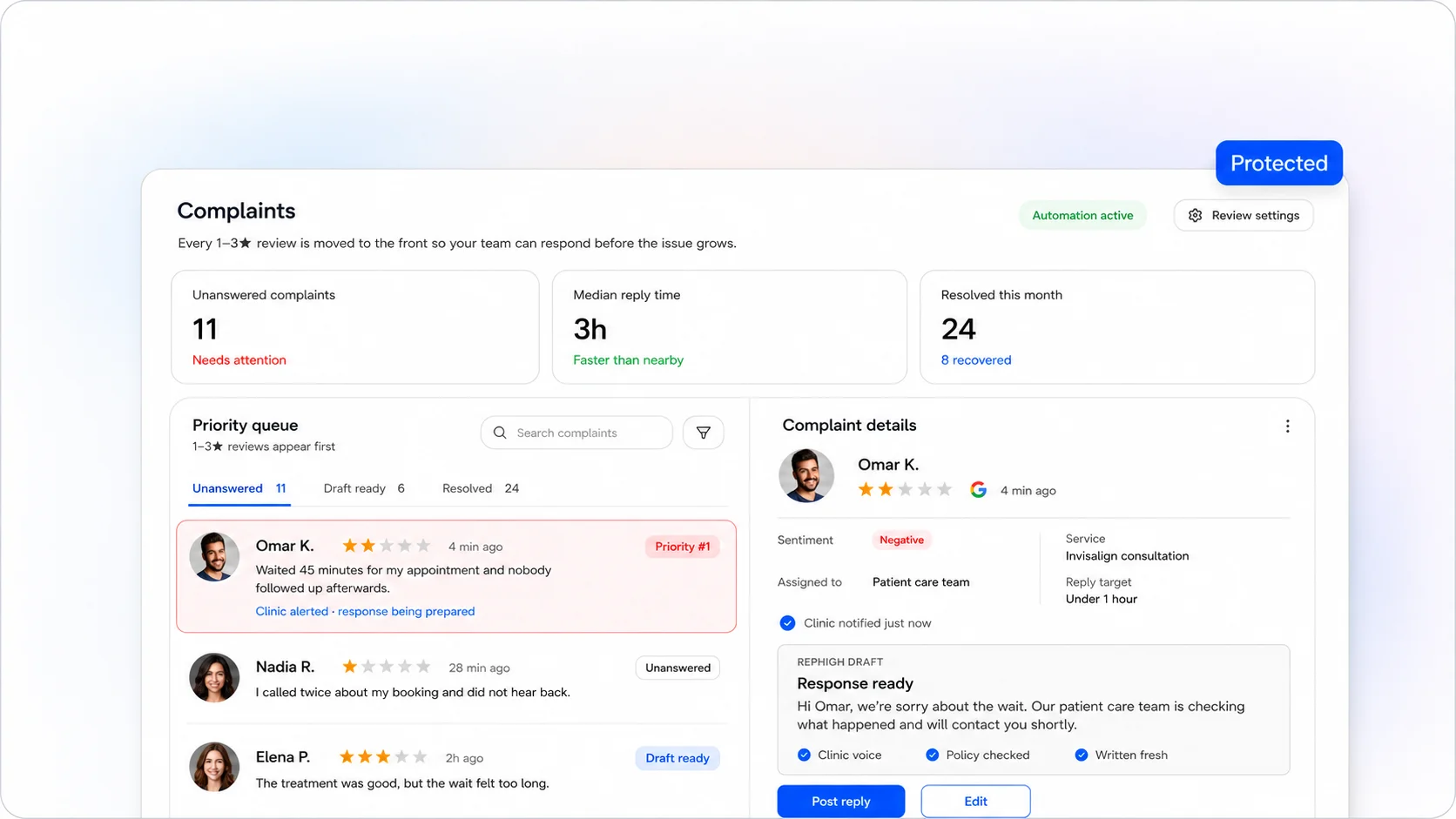
RepHigh Reputation Monitoring queueing unanswered one to three star reviews, with a drafted reply waiting for approval beside the complaint

Which metrics do we check?

Six signals shape whether a patient calls you or the clinic down the road. The free check reads the first four; the last two arrive with Reputation Monitoring.

  • Star rating and distribution: Your average score on Google, and the shape underneath it. A patient sees the average first. Then they read the split of five, four, three, two and one star reviews, and the two can tell opposite stories. A 4.3 built on two hundred five-star reviews and a few threes reads as a busy clinic with an off day. The same 4.3 sitting on a dozen one-star reviews reads as a pattern, and new praise will not hide it.
  • Review volume and recency: How many reviews you hold, how many arrived in the last thirty days, and how long it has been since the last one. Volume tells a patient the clinic is established. Recency tells them it is still busy. Recency is the half most clinics lose: three hundred reviews and nothing since February reads as a practice that has slowed down. Google treats the same rhythm as a sign the business is live.
  • Reply rate and reply speed: The share of your recent reviews that carry a reply, counted across the reviews we read rather than estimated from your lifetime total. We also measure the median hours from a review appearing to your reply going up. Speed only counts once replying is a habit: three or more replies, or every review answered. A clinic that answered one review out of thirty quickly was lucky, not fast. Where there is too little to measure, the report says so rather than inventing a median.
  • Unanswered negative reviews: Every one, two and three star review in the sample with no reply from the clinic. Each is listed with its date and text rather than reduced to a count. These are the reviews a prospective patient opens first, and every one is something you can answer today. Six or more unanswered scores nothing on this pillar. Even a single one costs you points, because to a reader it looks like nobody was listening.
  • Recurring complaint themes: The subjects that come up again and again: waiting times, pricing clarity, how the phone is answered, a particular treatment. One angry review is an incident. The same sentence in nine reviews is a process problem. Patterns tell you what to change in the clinic, not what to write back. That is the difference between a reputation that recovers and one that keeps producing the same complaint.
  • Local comparison: Where you sit against comparable clinics a few kilometres away on rating, volume and reply rate. Reputation is judged relatively. A 4.5 is strong in one neighbourhood and fourth place in another, and patients read you beside three other names in the same list. This is the number that explains why enquiries go elsewhere when nothing about your own profile has got worse.

Four of the free signals carry a score worth ten points each: reply rate, velocity, unanswered complaints and reply speed. The star rating and its distribution are reported alongside them as context rather than scored.

How to read your reputation score

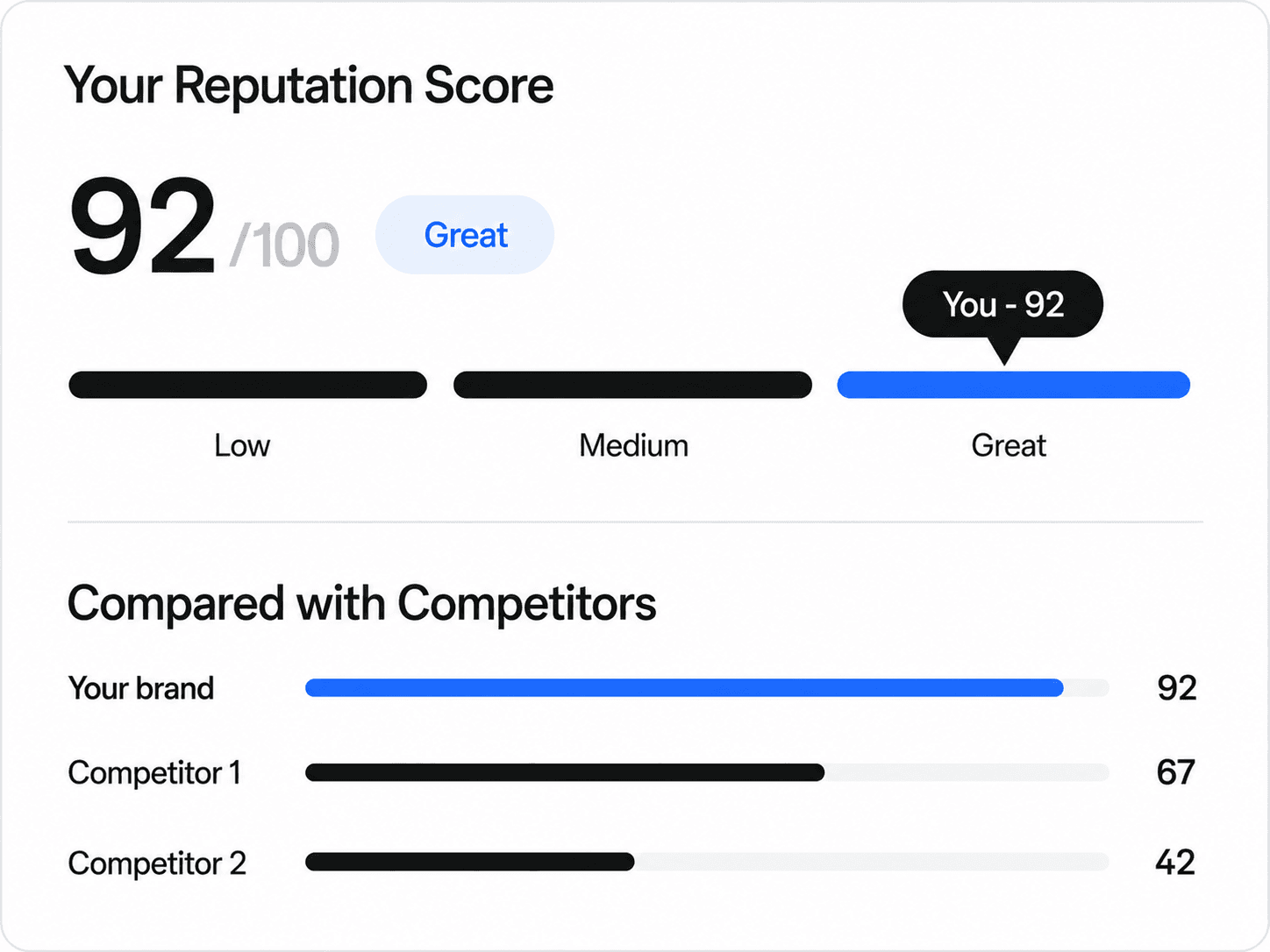
The score is one number for how your Google presence is being maintained, out of 100.

It is built from four signals worth ten points each: how many recent reviews carry a reply, how many arrived in the last 30 days, how many negative reviews are still unanswered, and how quickly replies go up.

A high score means the profile is being worked. A low one almost always means reviews are sitting unanswered, or that none have arrived for a while.

Treat it as a baseline. Work down the weakest pillar, then re-run the check to see which fix moved the number.

A reputation score of 92 out of 100 in the Great band, shown beside two competitors

How to improve your Google reputation

Six things that move the score, in the order they usually pay off.

Answer every unanswered review

Start with the one and two star reviews, oldest first. A short, factual reply that acknowledges the issue and offers a route to resolve it changes how the whole profile reads. Keep patient details out of the reply: DHA and PDPL both bind what you may say in public. Read the compliance rules.

Ask for reviews as part of the visit

The best moment is while the patient is still in the clinic or within a few hours of leaving. One link sent over WhatsApp outperforms posters and verbal reminders.

Keep a steady flow rather than a burst

Twenty reviews in one week looks worse than four a month for a year. Consistent recency is what keeps you visible in local results and credible to patients.

Fix the complaint patterns, not just the replies

If waiting times or unclear pricing come up repeatedly, the review is a symptom. Change the process, then say so in your replies so future readers can see it was addressed.

Complete and maintain your Business Profile

Accurate hours, services, treatment categories and recent photos. An incomplete profile suppresses the ranking your reviews have earned.

Re-check monthly and watch the trend

Reputation moves slowly and slips quietly. A monthly check tells you whether the habits are holding and where nearby clinics have pulled ahead.

RepHigh, in-house, or an agency

The same work, done three ways. What differs is who carries it, how fast it happens, and what it costs you each month. The plans are on pricing.

CapabilityRepHighMonitoring planDo it yourselfReception teamHire an agencyRetainer
How fast a review is answeredA draft is waiting the same day, for you to approveDays, and only once the desk is quietBatched into the next reporting cycle
Who writes the replyDrafted in your clinic’s voice, you approve every wordWhoever is on reception that morningA copywriter who has never treated a patient
DHA and PDPL safetyPatient details are kept out by rule, not by memoryDepends entirely on who is typingGeneralist teams rarely know the DHA rules
Asking for the reviewSent on WhatsApp after every completed visitA poster at the desk and good intentionsOccasional campaigns, when briefed
Where you stand locallyRating, volume and reply rate beside nearby clinicsA manual search, if anyone finds the timeOne slide in the monthly deck
Your team’s time each monthReading and approving, nothing elseSeveral hours, never billed to anyoneBriefing calls and report meetings
What it costsOne fixed subscription, whatever the volumeNothing on paper, paid in staff hoursA retainer, usually the largest of the three

Reputation questions, answered.

Rubric and copy last updated 13 August 2026.

Can a clinic delete a bad Google review?

No. Nobody can delete a Google review except the person who wrote it. The only route open to a business is reporting a review that breaks Google’s content policies, and Google states plainly that you should not report a review just because you disagree with it or dislike it. A truthful review you find unfair is not eligible for removal, and the week spent chasing it is a week not spent on the reply. What you can change is everything around it. A short, factual, unemotional reply changes how that review reads to the next patient, who is weighing your response as much as the complaint itself. A steady flow of recent reviews changes what the profile averages to. One bad month stops being the headline once the twenty reviews above it are recent and answered. The work is to outweigh and out-answer, not to remove.

Is it against Google’s rules to ask patients for reviews?

Asking is allowed. Google’s prohibited content policy explicitly permits soliciting reviews that represent a genuine experience. Three things are not allowed, and clinics tend to do all three by accident. Offering anything in exchange is banned, and Google names payment, discounts, free goods and free services. Selective asking is banned: Google prohibits merchants from discouraging negative reviews or selectively soliciting positive ones, the practice known as review gating, so filtering patients by how pleased they seem breaks the policy even though it feels like ordinary judgement. And Google says merchants should not pressure people to write a review while still on the premises, which rules out the tablet at the reception desk. What remains is the approach that works better anyway: ask every patient, shortly after the visit, on a channel they already use, and offer nothing for it.

How should a clinic reply to a negative patient review?

Reply publicly, briefly, and without confirming that the person was ever a patient. That last part is what clinics get wrong under pressure. Whether someone attended your clinic is not yours to disclose in public, and in Dubai both the DHA advertising rules and the UAE Personal Data Protection Law bind what a clinic may say about care. A reply that works has three parts and no fourth: acknowledge the experience as it was described, state the process you follow, and offer a private route to resolve it. Do not name a treatment, a date, a clinician or a fee. Do not correct the reviewer’s account in public, even when you are certain they are wrong. The reply is not written for the reviewer, who has already decided. It is written for the next patient reading it, who is deciding whether this is a clinic that listens or a clinic that argues.

What is a good Google rating for a clinic?

There is no threshold, because a rating is read relatively. A 4.5 is strong in one neighbourhood and fourth place in another, and a patient never sees your rating on its own. They see it in a list beside three other clinics, and that comparison is what decides the call. Rating also moves slowly and conceals more than it shows. Two clinics both sitting on 4.6 can look nothing alike: one has reviews from this month with the owner replying to each, the other has nothing since last year and four complaints still unanswered. A patient reads that difference in seconds. This is why the check scores four things rather than one: how often reviews arrive, how many carry a reply, how many negative reviews are still unanswered, and how quickly replies come. The average is an input. Those four are the reputation.

How is the reputation score calculated?

Four scored signals, ten points each, shown as a total out of 100: owner reply rate, review velocity over the last 30 days, negative reviews left unanswered, and median reply speed. Each is banded rather than scaled, so a clinic knows which band it sits in and what would move it up one. It is the same rubric the paid audit runs on, so your score does not change when you sign up.

How does the free check get my review data?

It reads what is already public on your Google Business Profile: the most recent 30 reviews, their dates, and whether each carries an owner reply. Nothing is posted, changed or requested on your behalf, and you never connect an account. The report tells you how far back those 30 reviews reach, because a clinic with 400 reviews and one with 40 are being read over very different windows.

Is the checker really free?

Yes. Three checks a day, no card and no account. A clinic’s reading is kept for 24 hours, so checking the same clinic again that day shows the same report rather than reading Google twice.

Does it work for clinics outside Dubai?

Yes. The check reads any listing on Google Maps, anywhere. RepHigh is built for private clinics in Dubai and the wider UAE, so the comparisons, the AED pricing and the DHA and PDPL guidance behind the paid product assume that market.

Stop guessing what patients see when they look you up.

The check tells you where your Google profile stands today. RepHigh keeps it there: every review answered in your clinic’s voice, and a review request after every completed visit.